In the digital world, data behaves much like a river system — it branches, flows, and sometimes floods. As businesses expand globally, this river must find paths through multiple terrains — continents, clouds, and data centers — while staying fresh and fast. Cross-region replication, then, is the engineering art of ensuring that every tributary carries the same clean water, without overflowing the budget or delaying the stream. It’s a delicate dance between speed, cost, and consistency — and how we choreograph that determines the rhythm of modern, resilient systems.
1. The Mirage of Instant Data: Why Cross-Region Replication Matters
Imagine a customer in Tokyo adding an item to their cart on an e-commerce site while another in Paris checks inventory for the same product. Both expect real-time accuracy. Behind the scenes, data must leap across oceans, synchronize with distant servers, and stay consistent — all within milliseconds. That’s the promise and the paradox of cross-region replication: achieving speed without sacrificing fidelity.
For developers, this is not just a database problem — it’s an architectural philosophy. Balancing low latency with global availability means deciding where to replicate, how often to update, and what to prioritize when bandwidth, time, or cost run short. It’s the sort of technical nuance that a full stack developer course often uses to teach scalability — how frontend experiences depend on the backend’s invisible choreography of data movement.
2. Strategy One: Active-Active Replication – The Symphony of Sync
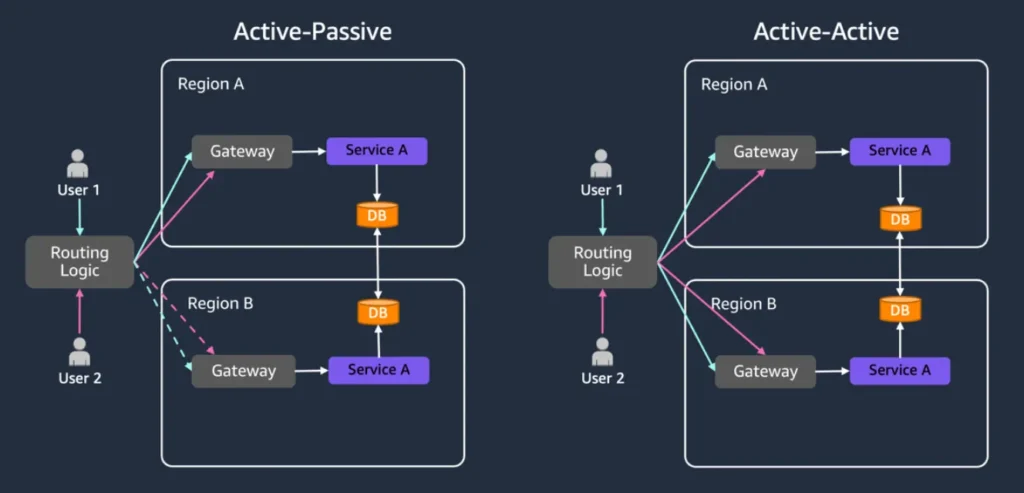
In an active-active replication model, every data center is a lead performer. Each region handles both read and write operations, continuously syncing with its global peers. When executed well, this feels like a live symphony — seamless, vibrant, and responsive. Users experience ultra-low latency, and the system remains resilient even if one region goes dark.
However, perfect harmony is expensive. The cost of continuous data synchronization grows with each new region. Bandwidth costs rise, storage multiplies, and conflict resolution logic becomes a daily operational reality. If two regions write to the same data simultaneously, who wins?
Netflix faced this challenge when ensuring uninterrupted streaming across continents. They embraced active-active replication with Amazon DynamoDB Global Tables to maintain high availability. Yet, even they admit: the orchestration is costly, and latency optimization never fully ends. Organizations choosing this strategy must decide if the applause for near-zero downtime is worth the extra instruments in their orchestra.
3. Strategy Two: Active-Passive Replication – The Shadowed Reflection
Active-passive replication is like a mirror — one region leads (the active node), and others follow (the passive replicas). It’s efficient and cost-effective because only one region handles writes, while others stand ready to take over if disaster strikes. This method is beloved by companies seeking global reliability without global expense.
Yet, mirrors have lag. When the active node writes data, replicas take a moment — seconds or even minutes — to catch up. This delay can cause temporary inconsistencies, a situation engineers call replication lag. For systems like financial platforms or multiplayer gaming networks, even that lag can break user trust.
A well-known SaaS platform once discovered that users in Asia saw slightly outdated dashboards because updates originated from servers in Virginia. They switched to a hybrid replication model, reducing cross-region write operations but improving freshness for frequently accessed data. The trade-off? A modest increase in storage cost, but a sharp drop in customer complaints.
This balance between “instant but costly” and “slightly delayed but affordable” is exactly the kind of engineering judgment explored in a full stack developer course in Hyderabad, where teams simulate disaster recovery and replication lag to understand how latency impacts user satisfaction.
4. Strategy Three: Asynchronous Replication – The Time Traveler’s Dilemma
Asynchronous replication embraces delay as part of its identity. Data changes are sent to other regions in batches or intervals, not instantly. This approach drastically cuts network costs and bandwidth usage, making it ideal for non-critical or analytics-heavy workloads.
But the trade-off is temporal: users in one region may briefly see older data compared to another. Think of a global news app — breaking stories appear first in New York and a few seconds later in Mumbai. For non-transactional systems, that’s acceptable. But for e-commerce checkouts or hospital records, such “time travel” can cause chaos.
Google Cloud Spanner and AWS Aurora have both tackled this through semi-synchronous models, blending low latency with data integrity. Yet, even with innovation, asynchronous replication remains a reminder that technology always negotiates with physics — data can’t outrun the speed of light.
5. Cost vs. Latency: The Great Balancing Act
Cross-region replication is ultimately an economic question disguised as an engineering one. Every millisecond shaved off latency adds a few more digits to the cloud bill. Every replica node means additional infrastructure, bandwidth, and monitoring.
The challenge lies in designing replication that fits the business use case — not the other way around. A fintech startup may justify active-active replication across continents to meet real-time compliance demands, while a media company may find asynchronous replication perfectly adequate for content delivery.
It’s this art of compromise — not just code — that defines the modern infrastructure architect. Understanding where to invest in speed and where to economize is a lesson as critical in cloud strategy as it is in any full stack developer course that bridges technical depth with business sense.
Conclusion: Building Bridges, Not Just Backups
Cross-region replication isn’t merely about copying data; it’s about building trust across time zones. Every architectural choice — whether synchronous or delayed, mirrored or multi-mastered — carries echoes of that trust. It asks: how much latency will users forgive, and how much cost can a business sustain?
The engineers who master this balance build more than systems; they build experiences that transcend geography. Just like a well-orchestrated river that flows seamlessly through valleys and cities, data too can move fluidly across the world — clean, fast, and reliable — when guided by thoughtful hands and disciplined strategy.
For more details visit us:
Name: ExcelR – Full Stack Developer Course in Hyderabad
Address: 49, 2, Unispace Building, 4th-floor, Plot No.47 48, Street No. 1, Patrika Nagar, Madhapur, Hyderabad, Telangana 500081
Email: enquiry@excelr.com
Phone: 08792483183